Pole push
The arms pull and press the poles back to the hip; in double poling they deliver most of the power on the flat.
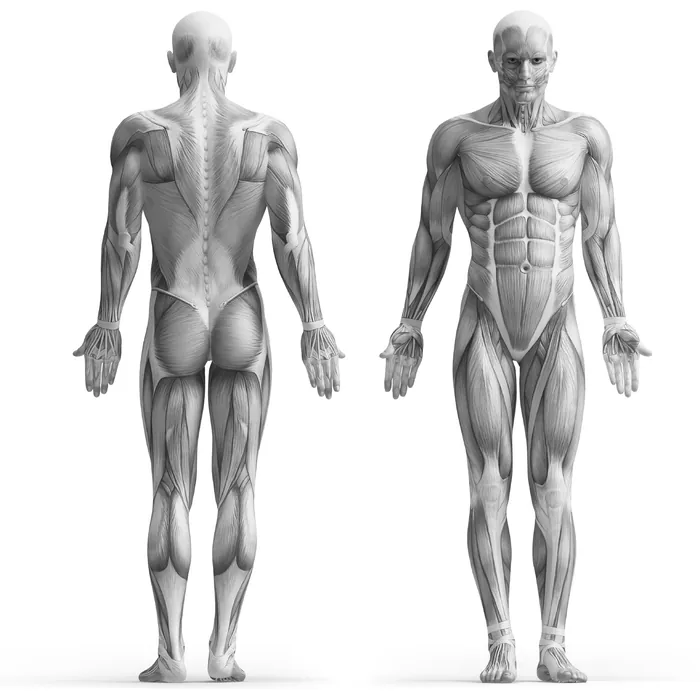
- LD Latissimus dorsi · not doing its share
- GT Gluteus maximus · where the load lands
- TB Triceps brachii
- SH Shoulder set (infraspinatus, teres major, rear deltoid)
Chain A lat on one side not doing its share → the opposite glute and push leg.
Trunk
The trunk bends onto the poles and the spine holds it.
- TR Trunk (obliques, rectus abdominis) · not doing its share
- ES Erector spinae · where the load lands
- LD Latissimus dorsi
Chain The trunk bending under the pole load about once a second → the lower back.
Hip
The hip extends in the rise and the push-off; it is the main hip job in diagonal stride and V2.
- GT Gluteus maximus · not doing its share
- LD Latissimus dorsi · where the load lands
- TB Triceps brachii
Chain A glute on one side not doing its share → the opposite lat.
Leg push
The knee extends and is controlled in the leg push: the kick, or the skating push.
- GT Gluteus maximus · not doing its share
- VL Vastus lateralis · where the load lands
- VM Vastus medialis
- RF Rectus femoris
- GME Gluteus medius
Chain Glute and quads on the lagging side giving way → the front and the outside of the knee.
Foot push
The calf pushes the foot down at the end of the leg push.
- GM Gastrocnemius medialis (inner calf) · not doing its share
- SO Soleus · where the load lands
- GL Gastrocnemius lateralis (outer calf)
- VL Vastus lateralis
Chain A long, heavy kick where the ski can't be unloaded → the calf, Achilles and foot.