Acceleration
The hips drive the body forward on every step, and the back of the body must be pre-tensioned before the hamstring is asked to brake.
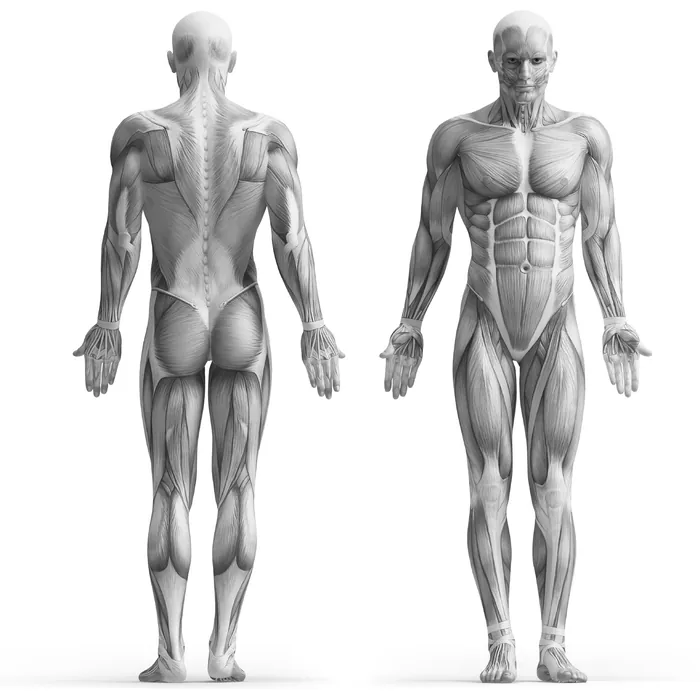
- GT Gluteus maximus · not doing its share
- BF Biceps femoris (outer hamstring) · where the load lands
- GM Gastrocnemius medialis (inner calf)
- SO Soleus
- ES Erector spinae
Chain A glute that contracts slowly → the upper hamstring on the same side.
Top speed
At the end of each swing the hamstring brakes the lower leg at its peak load, and it has to let go again within a ground contact of about a tenth of a second.
- GT Gluteus maximus · not doing its share
- BF Biceps femoris (outer hamstring) · where the load lands
- ST Semitendinosus (inner hamstring)
- GME Gluteus medius
- TR Trunk (obliques, rectus abdominis)
Chain A slow-contracting glute → the outer hamstring at the end of the swing.
Speed endurance
Late in a 400 m the calf is asked for more work while its spring returns less, and the trunk brace stops supporting the back of the body.
- GM Gastrocnemius medialis (inner calf) · not doing its share
- SO Soleus · where the load lands
- RF Rectus femoris
- ES Erector spinae
- TR Trunk (obliques, rectus abdominis)
Chain A tiring calf → the Achilles tendon in the final 100 m.
Finish
Fatigue, technique loss and a pelvis that stops holding: the engine calls the last 10–20 m the highest injury window of the race.
- GT Gluteus maximus · not doing its share
- BF Biceps femoris (outer hamstring) · where the load lands
- TR Trunk (obliques, rectus abdominis)
- ES Erector spinae
Chain A tired glute and trunk stop holding the pelvis → the pelvis tips forward → the hamstring is stretched further at the end of the swing → the outer hamstring (biceps femoris).